Four suits. One rank comparison.
A heart does not outrank a spade in the standard main game. Q♥ and Q♣ are equal-ranked Queens, so their different suits do not break the Tie.
Your Dragon Tiger game guide
Two cards. One clear result.
Explore Dragon Tiger online, learn the card rankings and understand Dragon, Tiger and Tie. Compare live dealer and RNG versions, with clear explanations of payouts and table-specific rules.
Get to know the table
An independent Dragon Tiger guide for India. For adults 18+.
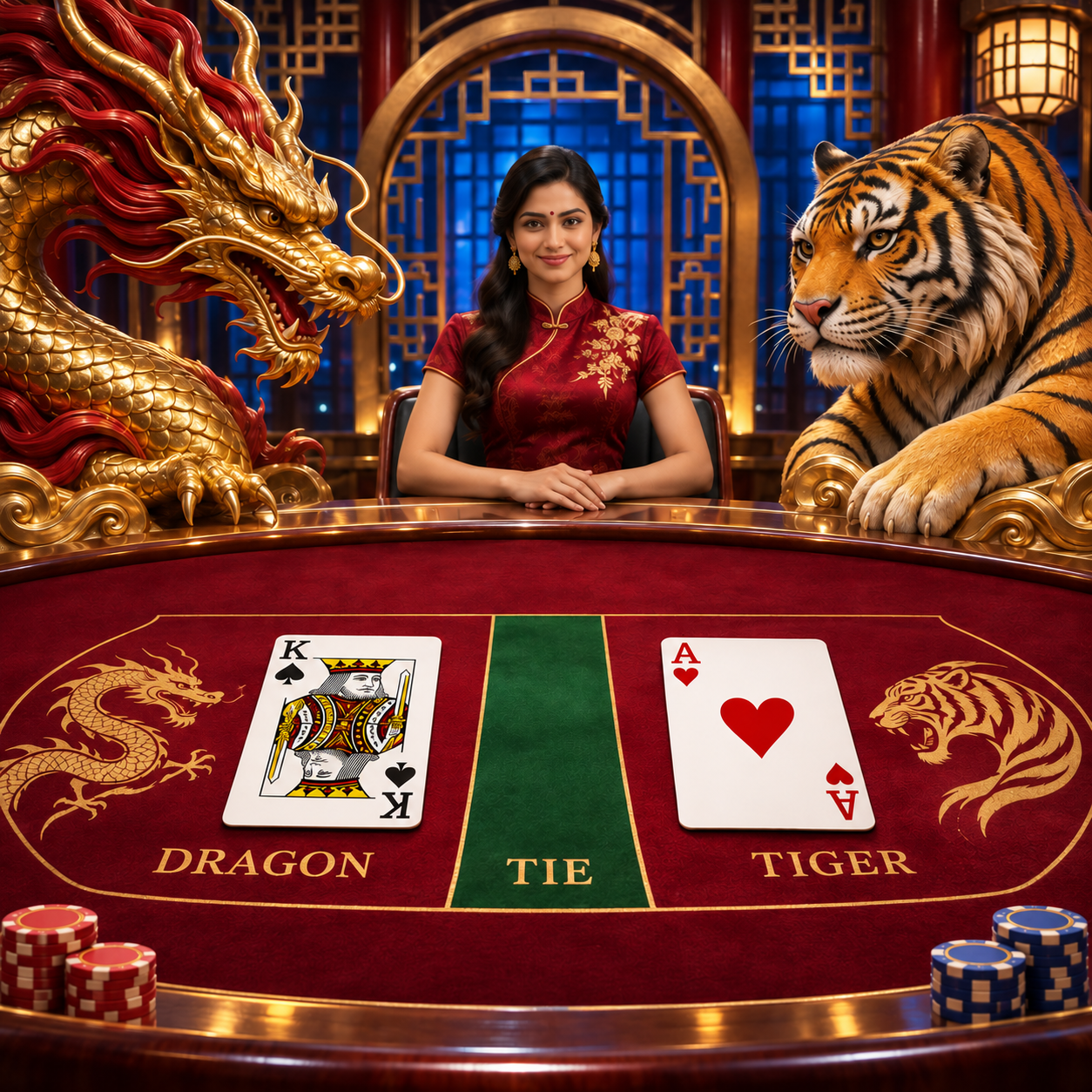
Dragon Tiger compares two cards: one for Dragon and one for Tiger. The higher rank wins; equal ranks produce a Tie.
The standard order is A, 2, 3, 4, 5, 6, 7, 8, 9, 10, J, Q, K. Suits do not decide the main Dragon or Tiger result.
A 1:1 winning payout means 100 credits of profit on a 100-credit stake. With the original stake returned, the total is 200 credits.
Dragon Tiger online can use a live studio feed or a virtual table. The provider and version determine the rules and available features.
In standard versions, Ace is lowest and King is highest. Check the selected version’s rules.
No. Providers publish different Tie payouts and can use different settlement rules. Use the exact table’s rules.
Roads and history panels record past results. A displayed streak does not guarantee the next result.
The hero image is an illustration. This page explains the game and its different versions.
One card for Dragon. One for Tiger. The higher rank wins. Learn to separate the card comparison from the payout rule, especially when the two ranks match.
Choose a fixed example and compare the cards.
Read the hand
Dragon’s nine ranks above Tiger’s six. Dragon wins the main comparison; the different suits do not change that result.
Compare individual ranks. Dragon Tiger does not add cards into a baccarat-style hand total.
The standard order is A, 2–10, J, Q, K. Ace ranks 1; Jack, Queen and King rank 11, 12 and 13.
Equal ranks are a Tie. Some versions return half the main stake; a separate Tie bet has its own terms.
Recognise the card, then read its rank. Dragon Tiger compares one card on each side: from Ace at 1 to King at 13. The court cards keep their own values.
Selected card
The highest standard rank. A King beats a Queen and every lower rank; another King produces a rank tie.
King is 13, not 10. Dragon Tiger does not reduce court cards to baccarat-style point values.
Select any card to see its rank.
A heart does not outrank a spade in the standard main game. Q♥ and Q♣ are equal-ranked Queens, so their different suits do not break the Tie.
Suit, colour, Big/Small and Odd/Even selections ask different questions. Their exclusions and payouts belong to the selected table’s rules, not to the visual order of the cards.
Matching ranks create a Tie. A Suited Tie, where offered, requires both rank and suit to match. The distinction matters even when the two pictures look almost identical.
Both Queens have the same rank. This satisfies a rank-based Tie condition, but not a Suited Tie condition.
Identical cards can appear when the shoe contains multiple decks. Check whether the selected game offers a separate Suited Tie option.
The payout ratio describes profit. The total returned on a winning bet also includes the original stake. Follow the credits from the starting amount to the final return.
Original credits + profit credits
Use a whole number from 1 to 1,000,000.
Total returned on 100 hypothetical credits, including the original stake.
Published Tie example
These are documented examples, not a universal paytable or a statement of availability in India. Evolution’s public product page also lists Suited Tie at 50:1; it does not publish every main-bet condition.
Under a half-return rule, an original main stake of 100 credits returns 50. A separate Tie bet settles under its own payout terms.
A familiar title or studio does not establish identical payouts, fees or Tie settlement. These credit calculations are teaching examples, not transactions or a playable table.
The same two-card comparison can appear in a live studio or on a virtual table. Identify what produces the cards, how the round runs and which rules belong to that version.

A dealer handles cards in a studio and the video feed shows the round. The table sets the betting window and dealing schedule; multiple viewers can follow the same hand.
Camera presentation, side bets and published table limits belong to that specific version. A familiar studio setting does not establish an identical paytable.
The presentation is rendered rather than a live camera feed. Some versions let the player initiate a hand, deal practice hands or shuffle the virtual shoe.
Evolution First Person is one published example. Demo access and individual features depend on jurisdiction, so a rendered studio should not be mistaken for a live dealer feed.
Keep the cards, selection controls and round status visible. A browser version and an app can present the same game differently; check that the important table information remains readable.
Dragon Tiger is offered by different services. The game’s name alone does not identify one universal official app or installer. Match the provider, version and supported device before comparing features.
Practice credits are not withdrawable money. A free-play label does not establish that a live table or every feature is available; demo access and the included features can vary.
A Tie is a third outcome. In a full eight-deck shoe, before either card is known, Dragon and Tiger each have a 46.27% chance of the higher rank; equal ranks occur about 7.47% of the time.
| Bet | Assumed profit payout / rule | RTP | House edge |
|---|---|---|---|
| Dragon / Tiger | 1:1; Tie loses half | 96.27% | 3.73% |
| Tie | 8:1 | 67.23% | 32.77% |
| Tie | 10:1 | 82.17% | 17.83% |
| Tie | 11:1 | 89.64% | 10.36% |
| Suited Tie | 50:1 | 86.02% | 13.98% |
RTP is a theoretical long-run share of stakes returned under a specified mathematical model. It is not the percentage of hands a player wins, a short-session forecast or a guaranteed return.
These figures assume eight complete standard decks. The main-bet row also assumes a 1:1 win and loss of half the stake on a Tie. Different deck counts, fees or rules change the calculation.
Rank Tie probability: 31 ÷ 415. Main-bet house edge with half-loss on a Tie: ½ × 31 ÷ 415.
A short label can hide an important rule. Big, Small, Odd, Even and colour bets judge an individual card, rather than simply repeating the Dragon-versus-Tiger result.
A common split is Small A–6 and Big 8–K. A seven can lose on both. Confirm the boundaries and exclusions in the table rules.
Mathematical parity does not establish the pay rule. Some published versions exclude seven from both options; others use different parity rules or payouts.
These options inspect the suit colour of one specified card. They are separate from which side has the higher rank, and their payouts can differ between providers.
PokerStars’ published version excludes seven from both Big/Small and Odd/Even. That rule must not be copied onto every provider’s game. Check the payout, losing ranks and whether a side bet becomes unavailable partway through the shoe.
Also confirm which card the selection refers to. A Dragon main bet and a Tiger side bet answer different questions.
Road maps and result panels belong to the familiar Dragon Tiger interface. They record outcomes already observed; a visible pattern does not certify the next winner.
Several Dragon results in a row describe previous hands. They do not prove that Dragon must continue or that Tiger is now due.
Raising a stake after a loss changes the amount at risk. It does not remove the house edge or guarantee recovery.
Do not treat signals, result screenshots or a “hack” label as proof of access to future cards. Keep past results separate from claims about unknown outcomes.
Find the rule behind the label: card values, tied hands, online versions and the meaning of return percentages.
One card is dealt to Dragon and one to Tiger. The higher rank wins; equal ranks form a Tie. In standard versions, Ace is lowest and King is highest.
Not in the standard main game. Q♥ and Q♣ have equal rank. A separate Suited Tie condition, where offered, requires both rank and suit to match.
Some published versions return half the main stake and lose the other half. Read the selected table’s settlement rule; do not confuse a main bet with a separate Tie bet.
No. There are live studio versions and RNG / virtual-table versions. A rendered scene can look like a studio without being a live video feed.
The name is used by multiple providers and services. It does not identify a single universal official app. Device support and access depend on the exact service and version.
No. It is a theoretical long-run return figure under stated rules. It is different from the chance of winning a hand and does not predict an individual session.
No. The cards, credit arithmetic and history log on this page are teaching illustrations.
India’s Promotion and Regulation of Online Gaming Act, 2025 came into force on 1 May 2026. The government describes a prohibition on online money games, their promotion and related payment facilitation. This page is an independent informational guide.